Managing Lid Position to Control Convection in a Two-Zone Charcoal Setup
You control convection in a two-zone charcoal grill by keeping the lid closed-this traps heat and smoke, creating even airflow for consistent cooking. An open lid kills convection, leading to uneven results and heat loss. Proper lid positioning stabilizes temperature, supports smoke development, and prevents hot spots. Cracking the lid briefly can fine-tune airflow without derailing equilibrium. For best performance, match lid use with vent control. There’s more to optimizing your setup than just fire placement.
Notable Insights
- Keep the lid closed to maintain convection currents that evenly distribute heat across both zones.
- Open the lid only briefly to check food or adjust coals, minimizing disruption to convection and temperature.
- Use a snug-fitting lid to ensure consistent airflow and prevent hot spots during convection cooking.
- Adjust top vent openness with the lid closed to fine-tune convection strength and internal temperature.
- Avoid prolonged lid opening, which collapses convection and shifts cooking from even ambient heat to direct radiation.
How Lid Position Controls Heat in Two-Zone Grilling
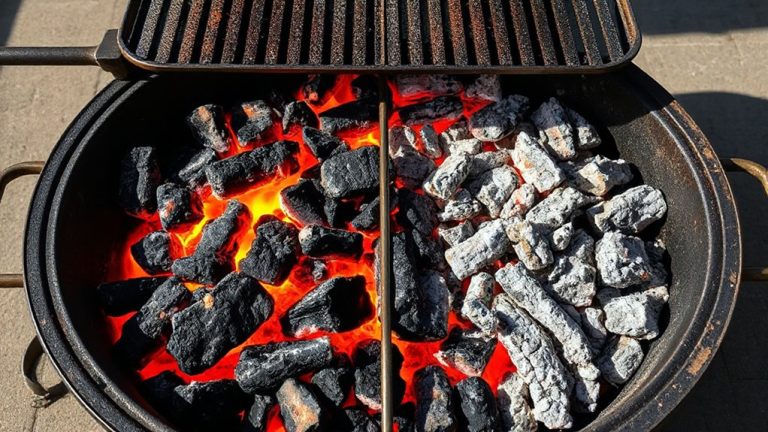
When you’re using a two-zone charcoal setup, the position of your grill’s lid plays a critical role in how heat circulates and stabilizes across the cooking surface. Keeping the lid on creates an oven-like environment, improving heat distribution and energy efficiency. Without it, heat escapes rapidly, creating uneven cooking and longer cook times. Proper lid alignment guarantees consistent temperatures between the direct and indirect zones, which is essential for searing and slow-cooking simultaneously. You’ll notice flare-ups decrease and temperature control sharpens when the lid fits snugly and vents are adjusted correctly. Misaligned or warped lids compromise performance, leading to hot spots and fuel waste. From a practical standpoint, maintaining full lid coverage during cooking delivers more predictable results, especially with thicker cuts. While some flare checks require brief lid removal, leaving it off for extended periods undermines the two-zone method’s effectiveness. In real-world use, lid position isn’t just about convenience-it’s a core factor in thermal management.
How Convection Works: Lid On vs. Off
Though you might think grilling is all about direct flame and surface heat, convection plays a bigger role than most realize-especially once you close the lid. With the lid on, hot air circulates above and around the food, creating consistent heat transfer that cooks more evenly. This enclosed environment improves thermal dynamics by trapping rising smoke and warmth, turning your grill into an oven-like chamber. Open the lid, and that convection collapses-heat escapes upward, leaving only radiant energy from coals. You lose temperature stability and efficiency. In a two-zone setup, maintaining convection with the lid closed is key for thicker cuts, ensuring they cook through without scorching. The control isn’t just about fire management; it’s about mastering airflow and retained energy. Lid position directly shapes thermal behavior, making it a critical factor in precision outdoor cooking.
Searing Steaks: Lid-Open for Direct Heat
If you’re aiming for a crisp, caramelized crust on a thick-cut steak, leaving the lid open while searing over the hot side of a two-zone grill gives you direct, unfiltered heat that builds surface char quickly. An open lid prevents heat from trapping above the grates, so you’re relying purely on radiant energy from the coals-ideal for precise control during direct searing. You can watch the steak closely, adjust its position over hot spots, and flip at the exact moment the surface darkens without risking overcooking the interior. While an open lid limits ambient temperature, that’s not a drawback here-steaks need intense surface heat, not indirect roasting. This method excels when you prioritize Maillard reaction over even doneness. For best results, use a well-preheated grill and avoid constant flipping. Direct searing with an open lid gives responsiveness and visibility, making it the go-to for chefs who value control in high-heat scenarios.
Smoking Ribs: Keep the Lid Closed for Control
You just finished searing steaks with the lid open, leveraging direct heat for a fast, controlled crust-but now it’s time to shift focus. Smoking ribs demands a different approach: keep the lid closed. This maintains a stable environment where convection circulates heat evenly, essential for developing ideal rib texture. When the lid stays shut, smoke builds gradually, allowing consistent smoke penetration without overwhelming the meat. Fluctuations in temperature and airflow from opening the lid disrupt this balance, leading to uneven cook times and potentially dry spots. You’ll notice a marked difference in tenderness and flavor depth when comparing ribs smoked with minimal lid disturbance. Properly closed, the grill retains moisture and smoke, letting collagen break down slowly while absorbing subtle wood notes. For best results, resist peeking-trust the process. Closed-lid smoking isn’t just about patience; it’s about control, yielding ribs with superior texture and balanced smoke penetration.
Adjust Airflow by Cracking the Lid
Why might you ever crack the lid on a smoker mid-cook? Sometimes, you need to fine-tune airflow without touching the air intake. A small lid gap increases oxygen flow, helping stabilize temperature when the fire starts lagging. It’s not ideal for long cooks, but briefly opening the lid lets you adjust convection without fully disrupting the environment. Unlike fully lifting the lid, a controlled gap reduces heat loss while still boosting combustion. Many pitmasters reserve this for mid-session tweaks, especially when the air intake is already wide open and more draft is needed. But be careful-too large a gap can create inconsistent airflow and uneven cooking. Used sparingly, a slight lid crack is a responsive fix, not a default setting. It works best when monitored closely, letting you balance draft and temperature with minimal disruption.
Stop Hot Spots With Lid Adjustments
A slight shift in lid position can do more than tweak airflow-it can reshape how heat circulates across the cooking chamber, especially when hot spots start skewing temperatures. You’ve likely noticed lid flutter when adjusting vents or wind hits your grill; that small movement can either stabilize or disrupt heat distribution. By slightly propping or reseating the lid, you minimize uneven radiation and convection, keeping your two-zone setup effective. Unchecked, those minor lid adjustments-or lack thereof-lead to heat spikes near the coals, threatening to overcook delicate items. It’s not just about closing the lid fully; precision matters. A tightly sealed lid retains consistent chamber heat, but a marginally lifted edge redirects rising heat, softening hot zones. Skilled pitmasters use this to their advantage, preventing thermal buildup without killing convection. In real-world use, managing lid placement proves essential for maintaining thermal balance across grates. Small corrections prevent big problems, making temperature control far more predictable and repeatable. Choosing the right best charcoal grills ensures better heat retention and airflow management for consistent results.
Use the Lid to Balance Smoke and Temperature
While maintaining clean smoke is essential for flavor development, the lid’s position plays a surprisingly active role in balancing both smoke density and chamber temperature. You control airflow and combustion efficiency every time you adjust the lid alignment, directly influencing how heat circulates and how smoke builds or clears. Too closed, and smoke becomes thick and acrid; too open, and you lose flavor and struggle to maintain thermal equilibrium. By partially closing the lid, you restrict oxygen just enough to sustain smoldering wood without overheating the fire zone. This creates clean, thin blue smoke-ideal for delicate flavoring. At the same time, proper lid alignment promotes even convection, helping your cooking chamber reach a stable thermal equilibrium. It’s not just about trapping heat-it’s about fine-tuning the environment. With careful adjustments, you balance smoke quality and consistent temps, ensuring your meat cooks evenly and tastes exceptional every time.
On a final note
You’ve seen how lid position shapes heat and airflow in a two-zone charcoal setup. Leaving it open boosts direct searing by reducing convection, ideal for steaks. Closing it traps heat and smoke, essential for even rib cooking. Cracking the lid fine-tunes temperature and smoke balance, helping eliminate hot spots. Proper lid management, paired with airflow control, delivers consistent results-making it a critical skill for effective, predictable barbecue performance.