Integrating PID Controllers Into Electric Smokers for Automated Temp Regulation
You’re upgrading your electric smoker’s reliability by integrating a PID controller for automated temp regulation. Instead of wild swings from basic thermostats, the PID adjusts power continuously, holding temperatures within a few degrees. This precision means consistent smoke profiles and better BBQ, especially on long cooks. With the right thermocouple, SSR, and proper wiring, your setup becomes a steady, hands-off cooking machine-and there’s more to optimize once you understand the full tuning process.
Notable Insights
- Install a PID controller to replace basic thermostats for precise, automated temperature regulation in electric smokers.
- Use a solid-state relay (SSR) to safely switch the heating element based on PID controller signals.
- Connect a Type K or Type T thermocouple to the PID for accurate, real-time temperature feedback.
- Mount all electronics in a heat-resistant, moisture-proof enclosure to ensure system reliability and safety.
- Perform auto-tune and manual calibration to optimize PID settings for stable, drift-free smoking temperatures.
Why PID Controllers Transform Electric Smokers
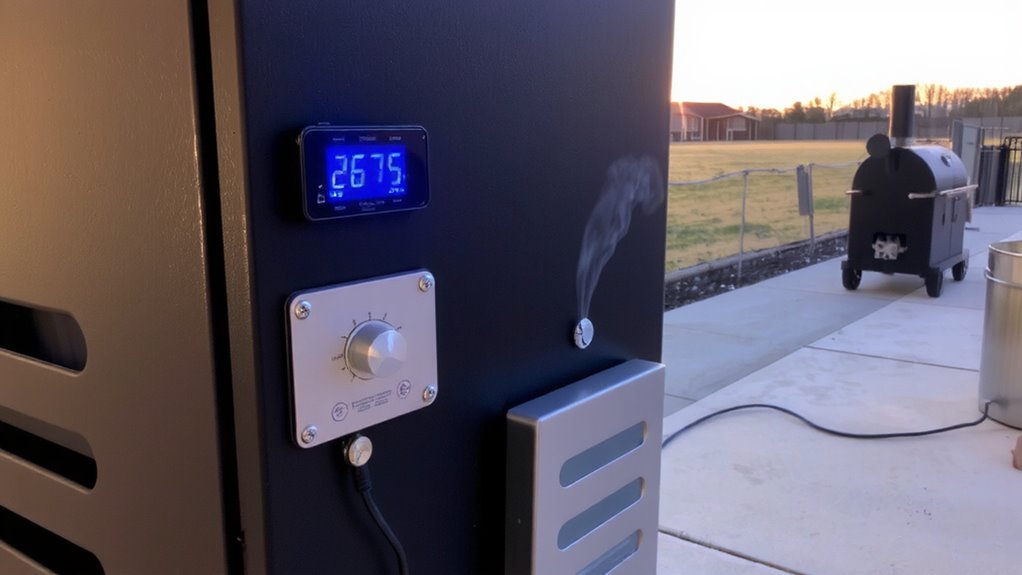
While most electric smokers rely on basic on-off cycling to manage heat, the ones equipped with PID controllers stand apart by delivering remarkably steady temperatures, and that’s where the real difference shows. You’ll notice the improvement the moment you monitor the internal chamber-it stays within just a few degrees of your set point, even in changing outdoor conditions. That level of temperature stability means more consistent smoke profiles and better-cooked meats, especially during long sessions. Unlike simpler systems, the PID doesn’t wait for large deviations before reacting. Instead, it continuously calculates adjustments, offering far better response accuracy. This kind of precision reduces guesswork and flare-ups, letting you focus on flavor rather than fixes. For anyone serious about outdoor cooking, it transforms the smoker from a basic appliance into a reliable, near-professional tool-worth the investment if consistent, hands-off results matter to you.
PID vs. Basic Thermostats: Smarter Control
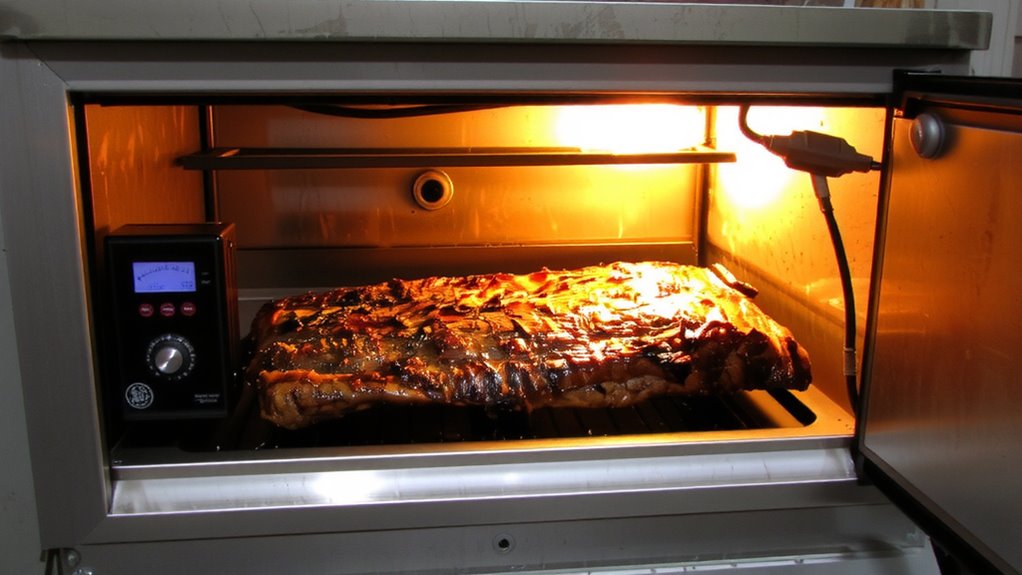
How do your ribs turn out so much better on some days than others, even when you follow the same recipe? Chances are, it’s your smoker’s thermostat. Basic thermostats cycle on and off, causing wild swings in temperature. You get poor temperature stability, so your meat cooks unevenly. With a PID controller, that changes. It constantly adjusts power to maintain a steady heat, giving you precision control. You’ll see real overshoot reduction, meaning the smoker won’t blast past your target temp and stay there. That’s key for low-and-slow BBQ, where consistency matters. Unlike basic thermostats that react after changes occur, PIDs predict them. The result? Reliable cooks, better texture, and fewer surprises. You’re not just hoping for good results-you’re engineering them. If you want repeatable, high-quality smoke sessions, upgrading from a basic thermostat isn’t just helpful. It’s essential for serious backyard BBQ.
Parts You Need for a PID Smoker Upgrade
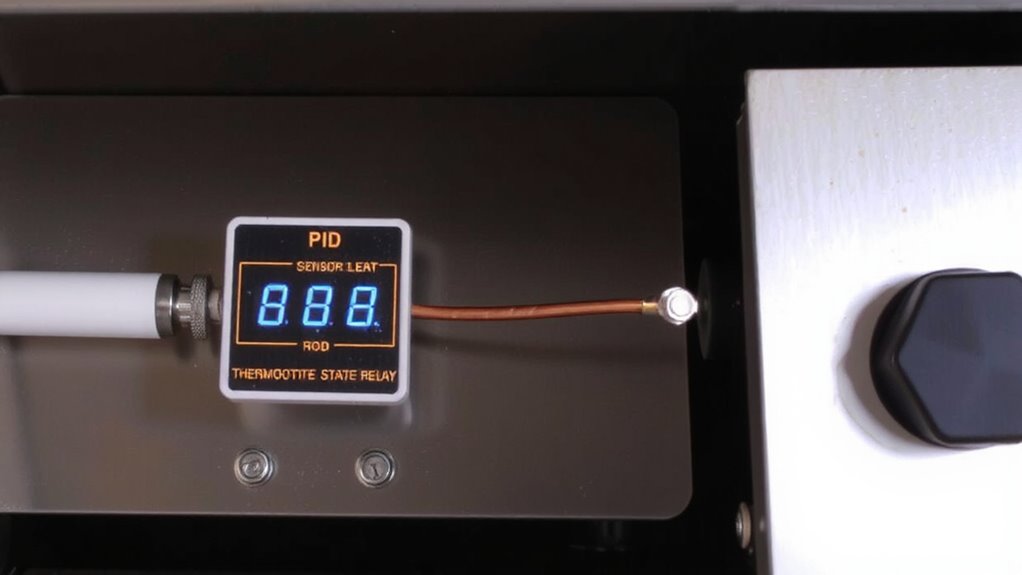
You’ve seen how a PID controller outperforms a basic thermostat by maintaining stable temperatures and reducing overshoot, which means your brisket won’t stall unexpectedly or your ribs dry out from heat spikes. For your smoker design to support this precision, you’ll need a few critical components: a PID controller unit, a reliable heating element, and a solid-state relay to handle the power load. Don’t forget a mounting enclosure that protects electronics from heat and moisture. Proper airflow management is essential-install an adjustable intake and exhaust damper to work in sync with the PID’s temperature adjustments. A well-placed fan can assist with even heat distribution, especially in larger chambers. Wiring must be heat-resistant, and all connections should follow electrical safety standards. When these parts integrate smoothly, your upgraded smoker delivers consistent performance, turning long cooks into repeatable successes rather than experiments.
Best Thermocouples for PID Smoking
Since temperature accuracy is critical when running a PID-controlled smoker, choosing the right thermocouple makes a real difference in how well your system responds to changes. You want minimal signal noise and fast feedback, especially during long cooks. Proper thermocouple placement-near the food and away from direct heat sources-ensures readings reflect actual cooking conditions, not hot spots. Type K thermocouples are popular for their wide range and reliability, while Type T suits lower-temp precision. Here’s a quick comparison:
| Type | Best For |
|---|---|
| K | High heat, versatility (up to 2300°F) |
| T | Low-temp accuracy, less signal noise |
| J | Budget builds, but prone to drift |
| N | Stable output, better resistance to aging |
Stainless steel-sheathed models resist corrosion and improve longevity.
How to Wire a PID Controller Step by Step
When wiring a PID controller for your electric smoker, getting the connections right guarantees stable temperature control and long-term reliability. First, disconnect power-safety comes before convenience. Match your voltage specs: most PIDs run on 120V, but double-check your smoker’s heating element. Connect the line voltage to the PID’s input terminals, observing wiring polarity to prevent internal damage. Your thermocouple plugs into the sensor input, usually labeled “+” and “−”-respect polarity here too for accurate readings. The output wires link to a contactor or SSR, which handles the load; this setup prevents a power surge from overloading the PID. Always use proper gauge wire and secure all connections with wire nuts or terminal blocks. Neat routing reduces risk and eases future troubleshooting. Done right, your PID will deliver consistent, hands-off smoking sessions for years.
Calibrating Your PID for Perfect Smoke
How precise is your smoker’s temperature reading, really? Even with a PID installed, inaccurate sensors or poor settings can throw off your cook. You need to validate the thermocouple against a known standard-like a calibrated grill thermometer-before tweaking values. Once you’ve confirmed sensor accuracy, focus on tuning stability. Start with the PID’s auto-tune function if available, then manually refine P, I, and D values to minimize overshoot and oscillation. Effective loop optimization means balancing response speed with control precision, ensuring temp swings stay within a tight range. That’s essential for low-and-slow BBQ, where even 10°F deviations affect bark formation and tenderness. Proper calibration isn’t a one-time setup; it’s ongoing maintenance. Recheck periodically, especially after firmware updates or hardware shifts. When done right, your smoker holds steady, delivering consistent, restaurant-quality smoke day after day. Beginners often find success with models designed for ease of use, such as the best electric smokers for beginners, which provide stable heating elements ideal for PID integration.
Fixing Common PID Smoker Problems
Why does your PID smoker still cycle wildly or respond too slowly, even after calibration? You might be dealing with sensor drift, where the temperature sensor gradually loses accuracy over time, throwing off readings and forcing the PID to overcompensate. This is especially common in older units or those exposed to constant thermal cycling. Worse, sudden power surges can scramble the controller’s logic or damage relay contacts, leading to erratic heating patterns or unresponsive controls. You should regularly verify your sensor against a known accurate thermometer and replace it if readings diverge by more than a few degrees. Use a surge protector to shield your PID from voltage spikes-especially important outdoors, where electrical conditions are less stable. Proper maintenance prevents most recurring issues, ensuring your smoker delivers consistent, low-and-slow performance ideal for barbecue. Don’t overlook these small failures; they sabotage precision and, ultimately, flavor.
On a final note
You’ve seen how PID controllers outperform basic thermostats with precise, adaptive temperature control. Upgrading your electric smoker with a PID and reliable thermocouple minimizes swings, ensuring consistent smoke sessions. Proper wiring and calibration are critical, but the payoff is steady, hands-off cooking. For serious outdoor BBQ, this mod boosts performance, fuel efficiency, and results-proving smart tech belongs in the pit just as much as in the kitchen.