Troubleshooting Common Temperature Fluctuations in Charcoal Grilling
You’re losing heat because airflow, fuel quality, and lid management are off. Open the bottom vent to feed oxygen to the coals-this controls burn rate-then adjust the top vent to regulate airflow. Spread high-quality charcoal like Kingsford evenly for consistent radiant heat, avoiding uneven piles that create hot spots. Keep the lid closed as much as possible; every peek drops temps fast. Rely on a dual-probe thermometer at grate level, since built-in gauges mislead. Stable burns start with smart setup and better tools.
Notable Insights
- Use high-quality, consistent charcoal like Kingsford briquettes to maintain stable and predictable temperatures.
- Adjust bottom and top vents systematically-control primary airflow with the bottom vent, fine-tune with the top.
- Spread coals evenly in a uniform layer to eliminate hot and cold spots across the cooking surface.
- Minimize lid openings to prevent rapid heat loss and use accurate, grate-level thermometers for monitoring.
- Shield the grill from cold winds and damp conditions to avoid disrupted combustion and excessive cooling.
Why Your Charcoal Grill Loses Heat
While it might seem like your charcoal grill should hold heat steadily once it’s lit, the reality is that several factors can cause it to lose temperature unexpectedly. You might not realize how much charcoal quality affects performance-lower-grade briquettes burn cooler and faster, giving you less control. On the other hand, high-density natural lump charcoal delivers more consistent, sustained heat. Weather conditions also play a big role: cold winds pull heat away, while damp air slows combustion. Even humidity impacts how long your coals stay hot. You’re not just managing fuel, you’re battling the environment. If you’re grilling on a blustery day, expect faster heat loss unless you adjust. Poor-quality charcoal worsens the problem, making temperature swings harder to predict. For steady results, use premium charcoal and account for outdoor conditions. It’s not just about lighting it and walking away-it’s about adapting as you cook. Choosing the right equipment, such as one of the best charcoal grills, can significantly improve heat retention and control.
Open Top or Bottom Vent? How Airflow Controls Heat
Getting the airflow right on your charcoal grill is the key to maintaining steady temperatures, and understanding how the top and bottom vents work together makes all the difference. You control combustion by adjusting vent positioning-more open means more oxygen, which increases heat, while closing them restricts airflow and lowers temperature. The bottom vent supplies primary air to the coals, directly influencing how quickly they burn, while the top vent releases smoke and hot air, creating a draft. Proper airflow dynamics depend on this balance: if you only tweak the top vent, you risk starving the fire or creating inconsistent draft. For best results, set the bottom vent first to establish heat level, then fine-tune with the top vent. This method gives you greater precision, stabilizes temperature swings, and improves cooking performance-especially during long sessions where consistent airflow dynamics are critical. A well-designed charcoal grill for camping can enhance airflow control and heat retention, making temperature management easier on the go.
Even Out Coals for Steady Heat
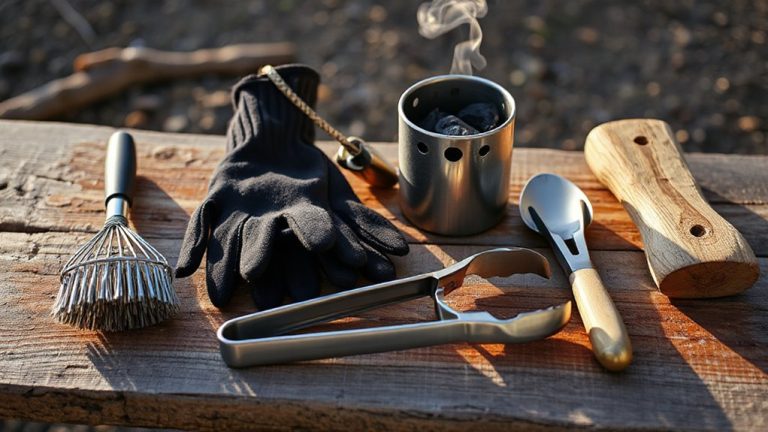
You’ve got your vents set and the airflow dialed in, but if your coals are piled unevenly, you’re still going to battle hot spots and erratic temperatures. Proper coal distribution is essential for stabilizing your grill’s heat zones. Spread the coals in an even layer across the base-about one to two inches thick-to promote uniform radiant heat. Clumps create intense heat zones, while gaps leave cold spots, making cooking inconsistent. Use tongs or a grill rake to arrange lit coals, adjusting density slightly if you want indirect heat on one side. This control lets you sear over high heat and finish over lower temps. A level bed of coals maintains steady combustion, reducing the need for constant vent tweaks. Even distribution isn’t just about symmetry-it’s a functional step that directly affects cooking performance and temperature predictability every time you grill. For delicate proteins like fish, maintaining consistent heat is crucial, and a well-balanced fire sets the stage for using the right best smokers for fish.
Stop Letting Heat Escape When You Peek
Why do your temperatures drop every time you lift the lid? Because heat escapes rapidly-up to 50 degrees in under a minute. Every time you check on food, you’re disrupting the cooking environment. High peek frequency is one of the most common causes of inconsistent grilling results. You don’t need to check every few minutes; trust your setup and resist the urge. Instead, rely on accurate thermometers in the lid and near the grates to monitor without lifting. Also, inspect your lid seal regularly. A degraded or warped gasket lets heat leak even when closed, making temperature control harder. Replace damaged seals to maintain efficiency. Minimizing lid openings and ensuring a tight lid seal aren’t just minor tweaks-they’re essential for stable, predictable cooking. Control peek frequency, preserve heat, and you’ll see better sear, more even doneness, and fewer surprises.
Kingsford vs. Lump: Pick the Steadier Burn
| Feature | Kingsford Briquettes | Lump Charcoal |
|---|---|---|
| Charcoal density | Uniform, high | Variable, less dense |
| Burn duration | Long, predictable | Short, aggressive |
| Heat consistency | Steady | Fluctuating |
| Ignition ease | Easy, uniform | Uneven, fast |
| Temperature control | More forgiving | Demands attention |
Choose Kingsford for reliability, especially in long sessions.
Ditch the Lid Gauge: Use a Reliable Thermometer
A common pitfall in charcoal grilling is relying on the built-in lid thermometer, which often gives misleading readings due to poor placement and low-quality construction. These gauges sit too far from the cooking grate, making lid accuracy questionable at best. You’re better off trusting a standalone, high-quality thermometer placed near the meat. Most factory-installed gauges lack gauge reliability, especially in fluctuating conditions or at lower temperatures. For precise control, use a dual-probe digital thermometer-ones with remote monitoring guarantee you’re not guessing. Don’t let a faulty reading ruin your cook; inaccurate temps lead to underdone or dried-out results. While the lid gauge might offer a rough idea, it shouldn’t guide important decisions. Invest in a reliable leave-in thermometer to monitor actual grate-level heat. It’s a small upgrade that dramatically improves consistency, helping you respond quickly to real temperature shifts instead of false signals from a flawed sensor.
Low and Slow? Keep Charcoal Grill Temperature Steady
Now that you’re using a reliable thermometer to read the actual temperature at the grate, you can focus on maintaining that steady heat-especially important when running your charcoal grill low and slow. A consistent fire configuration is key; opt for a two-zone setup with coals on one side and indirect heat on the other. This allows you to sear when needed and gently cook over time. Your charcoal arrangement directly impacts airflow and heat retention-tightly packed coals burn longer but may restrict oxygen, while spaced-out coals increase combustion. Adjust the vents gradually to avoid dramatic swings. With lid closed, monitor the thermometer and tweak oxygen flow as needed. A stable fire configuration reduces flare-ups and promotes even cooking, critical for ribs, brisket, or pork shoulder. Mastering this balance means better bark, juicier interiors, and fewer temperature spikes. Patience and precision beat guesswork every time.
On a final note
You’ve got the tools to manage heat now-control airflow, distribute coals evenly, and limit lid lifts. A reliable thermometer beats the built-in gauge every time. Kingsford offers consistency; lump burns hotter but less predictably. For low and slow, steady trumps intensity. Master these, and your charcoal grill becomes a precision tool, not a guessing game. It’s not about luck-it’s about technique, observation, and smart adjustments throughout the cook.