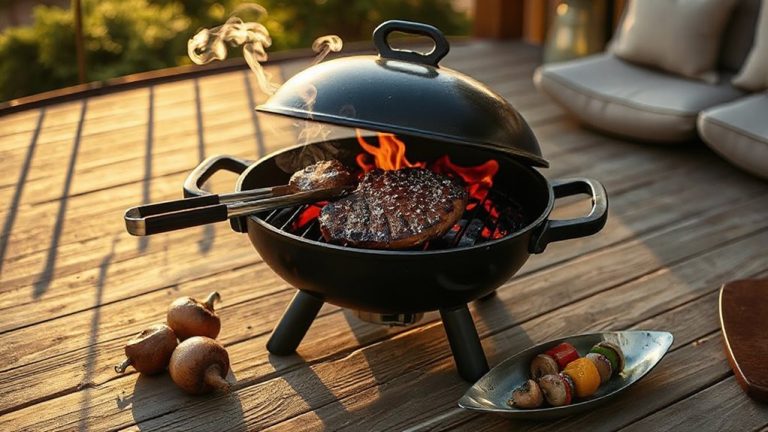
Balancing Charcoal Density and Airflow for a True 325°F Roasting Environment
You’ll need the right charcoal density and airflow to hold a true 325°F. Too few coals slow heat recovery; too many risk overheating. Use a two-zone setup with a tight, even layer of briquettes for steady output. Control combustion with intake and exhaust vents-small adjustments regulate oxygen and burn rate. A low, uniform stack promotes consistency while preventing hot spots. Mastering this balance means stable, predictable roasting every time-there’s more to fine-tuning your setup than just fuel and fire.
Notable Insights
- Use a moderate layer of uniformly sized briquettes for steady heat and better temperature control at 325°F.
- Position coals in a two-zone setup to enable indirect roasting and reduce temperature spikes.
- Maintain a tight, single-layer charcoal bed to ensure even ignition and consistent heat output.
- Adjust intake and exhaust vents incrementally to regulate oxygen and stabilize combustion without fuel changes.
- Monitor thermometer readings closely and fine-tune airflow to compensate for density-related heat fluctuations.
Why Charcoal Density Makes or Breaks 325°F
Every handful of charcoal you load into the chamber affects how steadily your grill holds 325°F, and getting that balance wrong can ruin an entire cook. Charcoal density directly shapes both heat retention and burn duration, meaning too little slows temperature recovery, while too much risks overheating. The charcoal composition-whether lump or briquette-determines consistency; lump burns hotter and faster, while briquettes offer more predictable, even output. Your ideal setup depends on which you prioritize. Ember distribution is just as critical: uneven piles create hot spots, leaving some areas undercooked. You need a tight, uniform layer for stable convection. Too loose, and airflow gaps cool the chamber; too packed, and oxygen can’t circulate. The goal is balance-enough mass to hold 325°F, but not so much that minor adjustments cause swings. Mastering this density keeps your roast steady, efficient, and repeatable. For those seeking top-performing equipment, the best charcoal grill smokers combine design features that optimize both airflow and fuel capacity.
How Airflow Keeps Your Charcoal Roaster Stable
While charcoal density sets the foundation for steady heat, it’s the airflow that actually steers your roaster’s performance, and getting it right means the difference between a rock-solid 325°F and a cook that spirals out of control. You need consistent oxygen flow to sustain charcoal ignition and prevent temperature drops that ruin roast integrity. Too little air, and your coals smolder weakly; too much, and you’ll overshoot your target fast. Proper airflow guarantees even ember distribution, which stabilizes heat across the cooking chamber. You’re not just feeding flames-you’re managing combustion efficiency. Adjusting intake and exhaust vents lets you fine-tune burn rate without adding fuel. Experienced roasters rely on airflow control to maintain thermal equilibrium over long cooks. It’s not passive-it’s active regulation. When calibrated well, airflow turns erratic burns into predictable, repeatable results, keeping your roaster stable, your embers uniform, and your 325°F target locked in.
Best Way to Arrange Charcoal for 325°F
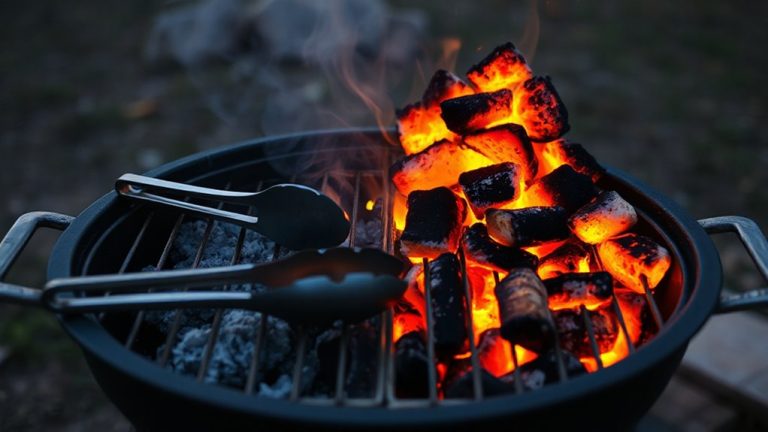
Getting the airflow right means little if your charcoal isn’t laid out to support steady, even heat from the start. For consistent 325°F roasting, strategic charcoal placement is essential. You’ll want a two-zone setup: pile most coals on one side to create your heat source, leaving the other side sparse. This allows indirect cooking and buffers temperature spikes. Aim for even fuel distribution within the main pile-no dense clumps or gaps-so combustion spreads uniformly. A tight, single layer of briquettes or lump charcoal works better than a deep stack, promoting full ignition and minimizing hot spots. Rotate a few coals if you see uneven glow, adjusting placement mid-roast only when necessary. Proper arrangement from the outset guarantees the fire sustains target temps with minimal correction. Smart fuel distribution and careful charcoal placement aren’t just prep-they’re the foundation of precision roasting. For reliable performance, consider models highlighted in the Best Charcoal Grills for 2025 guide to ensure optimal heat control and airflow design.
How Stack Height Controls Heat Consistency
A single layer of charcoal often delivers more stable heat than a tall stack, and here’s why: stacking too high traps embers, restricts airflow, and leads to uneven burn rates that make holding 325°F a constant battle. You need a balanced chimney draft to maintain clean, steady combustion-too much height disrupts it, starving the fire of oxygen. A low, even bed of coals creates a reliable thermal buffer, absorbing and radiating heat uniformly. This setup reduces peak temperatures and minimizes hot spots, giving you better control. Selecting the right grill design can significantly influence heat management, and understanding best charcoal grills helps ensure optimal airflow and temperature stability.
| What You Want | What High Stacks Feel Like |
|---|---|
| Predictable heat | Frustration |
| Even roasting | Burnt edges, raw centers |
| Smooth airflow | Suffocated flame |
| True 325°F | Constant vent tweaking |
Manageable stack height supports consistency-you’re not just burning charcoal, you’re engineering an environment.
Adjust Vents and Fuel to Hit 325°F Every Time
Usually, you’ll find that fine-tuning your grill’s vents and fuel load makes all the difference when targeting a steady 325°F. Proper vent tuning controls airflow, directly influencing combustion intensity-open them slightly to increase oxygen flow if temps lag, or close them to restrict burn rate when things run hot. Pair this with smart fuel grading: using uniformly sized briquettes or lump charcoal guarantees even burn and predictable heat. Irregular chunks cause hot spots and inconsistent output, undermining stability. You’ll want to start with a full but not overcrowded firebox, then adjust vents incrementally while monitoring with a reliable thermometer. Experienced pitmasters agree that mastering both vent tuning and fuel grading reduces temperature swings and sustains ideal roasting conditions. It’s not just about lighting the fire-it’s about managing its lifecycle. With practice, hitting 325°F every time becomes second nature, delivering consistent results across roasts.
On a final note
You’ve seen how charcoal density and airflow directly impact temperature control, and now it’s clear: maintaining 325°F hinges on balanced fuel stacking and vent management. A proper stack height guarantees even burn, while strategic vent adjustments fine-tune oxygen flow. This isn’t guesswork-it’s precision. With the right setup, your charcoal roaster delivers consistent, low-and-slow results, proving that technique and design matter most in reliable, flavorful outdoor cooking.