How to Maintain Consistent Temperatures on a Charcoal Grill in Windy Conditions
Position your grill sideways to the wind so gusts don’t blow straight through the fire and spike temperatures. Use a windbreak on the windward side to shield the coals without suffocating them. Align the intake vent upwind and exhaust downwind to harness natural draft. Set up a two-zone fire for better control, monitor temps with a reliable thermometer, and keep the lid closed to maintain stability-your setup will respond more predictably when you understand these adjustments.
Notable Insights
- Align the grill with vents perpendicular to the wind to prevent gusts from disrupting the fire and causing temperature spikes.
- Place a windbreak made of heat-resistant material on the windward side to shield the grill without suffocating the fire.
- Position the lower intake vent into the wind and the upper exhaust vent downwind to create a stable natural draft.
- Use a two-zone fire setup to buffer against wind-driven temperature swings and enable flexible cooking adjustments.
- Monitor temperatures with a precise standalone thermometer and keep the lid closed to maintain heat stability.
Position Your Grill for Windy Conditions
When grilling in windy conditions, positioning your setup correctly can make the difference between consistent heat and frustrating temperature swings. You need to take into account grill orientation-aligning the vents and draft doors perpendicular to the wind, not facing into it. This setup supports better airflow management by preventing gusts from blowing directly through the fire, which can spike temperatures or starve coals of oxygen. Most charcoal grills draw air from the bottom and exhaust at the top, so uncontrolled airflow disrupts combustion efficiency. Positioning the grill so wind crosses its side balances intake and exhaust, helping maintain a steady burn. You’ll notice fewer flare-ups and more predictable cook times. It’s not just about where you place the grill, but how its design interacts with the environment. Smart grill orientation doesn’t eliminate wind challenges, but it gives you far greater control over airflow management and cooking outcomes.
Use a Windbreak When Grilling in Wind
A well-placed windbreak can markedly improve your grill’s performance on breezy days by shielding the fire from erratic gusts that disrupt airflow and destabilize temperatures. You should position it on the side facing the wind direction, blocking gusts without suffocating the fire. Portable metal screens, a repurposed baking sheet, or even a grill cover on a stand work well, as long as they’re stable and heat-resistant. A good windbreak enhances heat retention by reducing convective cooling, helping the charcoal burn more efficiently. It’s not a one-size-fits-all solution-effectiveness depends on proper placement and material. You’ll notice more stable temps and fewer fuel top-ups. Unlike permanent structures, removable windbreaks offer flexibility and ease of storage. When used correctly, they’re a practical upgrade for outdoor cooking in exposed areas, balancing airflow control with consistent performance.
Set Vents to Work With the Wind, Not Against It
Since wind affects airflow dynamics more than most realize, adjusting your grill’s vents to align with the wind’s direction can make a noticeable difference in temperature control. Proper vent alignment isn’t just about opening or closing them-it’s about positioning. When wind hits closed or misaligned vents, it disrupts combustion, causing erratic burn rates and heat spikes. But when you orient the bottom and top vents to encourage airflow cooperation with the wind’s flow, you stabilize oxygen supply to the coals. This means the fire burns more predictably, even in gusty conditions. You’re not fighting nature; you’re using it. For best results, position the lower intake vent on the side facing the wind and the upper exhaust vent downwind. This creates a natural draft that sustains clean, efficient burning. Smart vent alignment turns wind from a problem into an ally. Choosing a model designed for airflow precision can further enhance performance-consider exploring top-rated options in our best charcoal grills roundup.
Stabilize Heat With a Two-Zone Fire
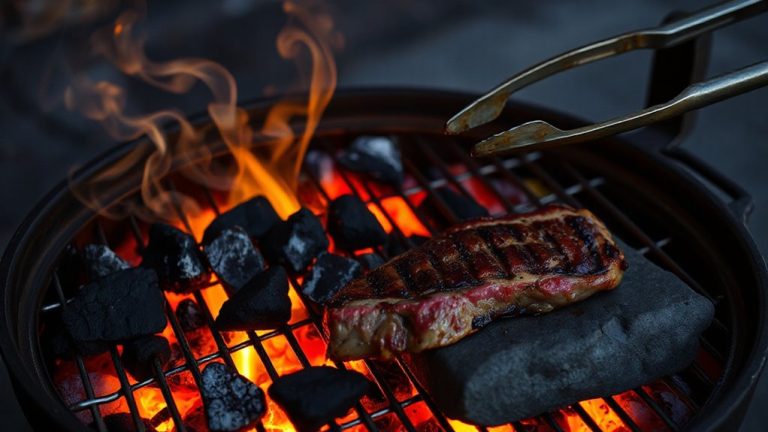
Every serious grill session benefits from the control a two-zone fire provides, especially when wind throws off heat consistency. You stack coals on one side, leaving the other empty, creating distinct cooking zones for searing and indirect heat. This charcoal distribution gives you flexibility-when gusts cool one side, you can shift food or adjust airflow without starting over. It’s a smarter approach to fire management, letting you respond to changing conditions instead of fighting them. Wind might disrupt airflow, but with a two-zone setup, you’ve already built in a buffer. Sear over high heat, then move to the cool side to finish cooking evenly. You’ll maintain better temperature control and avoid hot spots that lead to uneven results. This method isn’t just practical-it’s essential for reliable performance. Once mastered, it becomes the foundation of consistent, high-quality outdoor cooking.
Use a Grill Thermometer for Steady Heat
Temperature control separates the seasoned pitmaster from the guesswork crowd, and a reliable grill thermometer is your best tool for keeping heat steady when wind messes with airflow. You can’t manage what you can’t measure, so investing in a high-quality thermometer guarantees real-time temperature accuracy and consistent readings despite gusts. Many grills come with built-in thermometers, but they’re often poorly placed or lack precision-don’t trust them blindly. Perform regular grill calibration using a standalone digital probe to verify readings. A well-calibrated thermometer mounted in the lid lets you monitor ambient temperature without lifting the cover. Models with dual probes give even better control, tracking both air and food temps. With accurate feedback, you’ll adjust vents and fuel more effectively, maintaining ideal cooking conditions even when wind disrupts convection. Trust the data, not instinct. For the most reliable results, choose a model from a list of the best meat thermometers.
Keep the Lid Closed When Grilling in Wind
You’ve got a solid thermometer in place, giving you reliable feedback on your grill’s internal climate, but that data won’t do much good if you’re constantly lifting the lid to peek at your food. Every time you open it, you disrupt lid sealing and lose valuable heat retention-often up to 50% in just a few seconds. In windy conditions, this loss is even harder to recover, making temperature control a constant battle. Keeping the lid closed isn’t just about patience; it’s about maintaining a stable cooking environment. Wind can already challenge airflow and burn rate, so preserving internal heat becomes critical. Frequent opening leads to uneven cooking, longer grill times, and wasted fuel. Trust your thermometer and resist the urge to check. A well-sealed lid locks in warmth, protects the cooking zone, and guarantees consistent results, even when gusts roll through.
Understand How Wind Affects Grill Heat
While wind might seem like a minor disruption, it can drastically alter your grill’s heat dynamics, especially if you’re relying on consistent temperatures for precision cooking. Wind causes airflow disruption by forcing excess oxygen into the coals, which can spike temperatures unpredictably. At the same time, it pulls heat away from the cooking chamber, accelerating heat loss. This dual effect makes temperature control challenging, often resulting in unevenly cooked food. You’ll notice gusts interfering most when grilling low-and-slow or searing steaks, where stability matters. Using a windbreak helps, but positioning the grill at a 90-degree angle to the wind minimizes direct exposure. Monitoring with a reliable grill thermometer lets you react before small fluctuations become major issues. Ultimately, understanding how wind impacts airflow disruption and heat loss gives you greater command over outdoor cooking conditions, making your results far more predictable and consistent.
On a final note
You’ve got to work with the wind, not against it, if you want steady heat on a charcoal grill. Positioning the grill correctly, using a windbreak, and adjusting vents strategically all make a measurable difference. A two-zone fire gives you control, while a reliable thermometer helps you monitor fluctuations. Keeping the lid closed maintains internal temperature, even in gusts. These methods, grounded in airflow physics and tested in real conditions, are essential for consistent, high-quality BBQ under challenging weather.